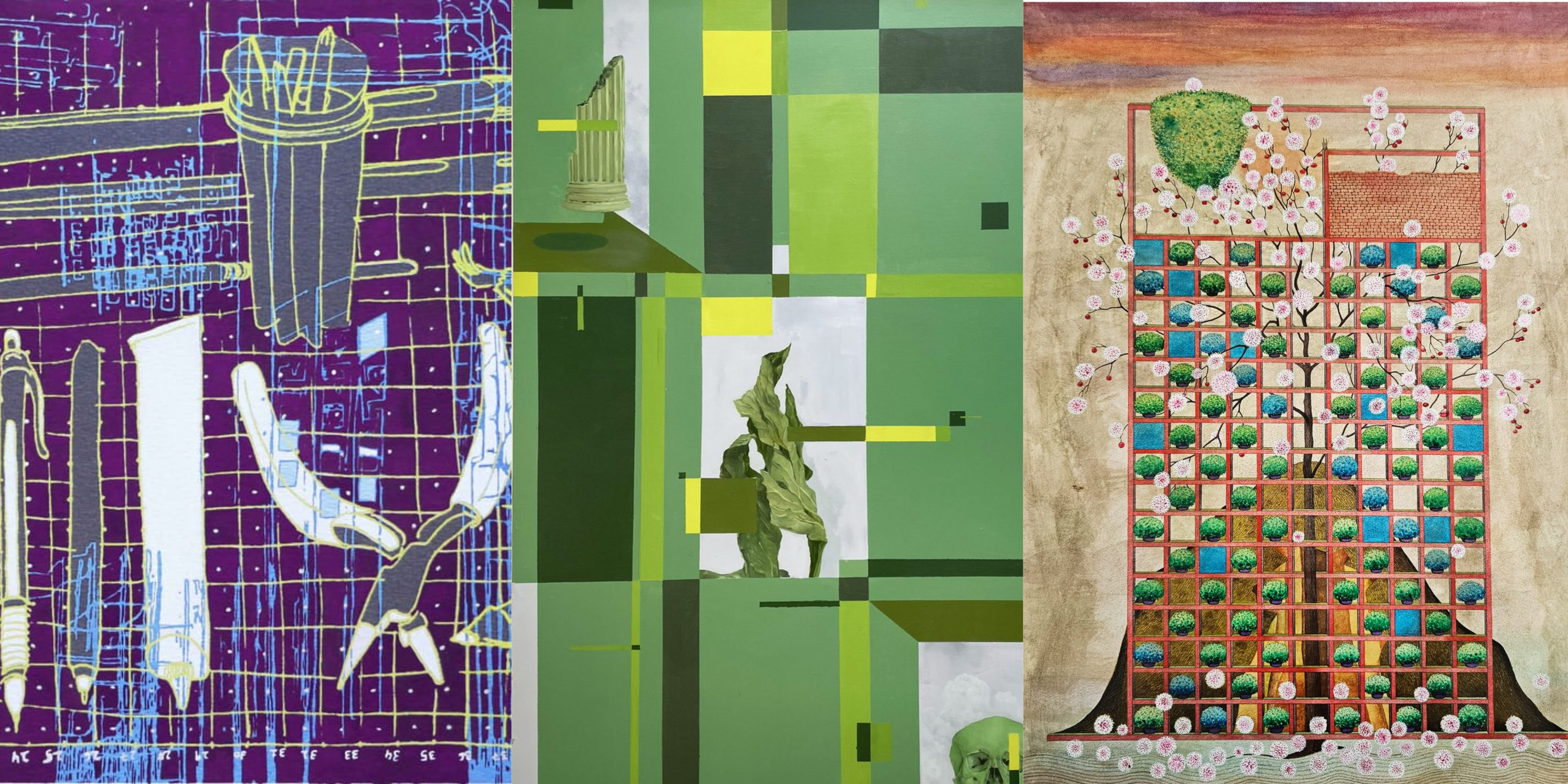
Take a look at everything that surrounds us. Everything is governed by order, structure and alignment, by the discipline of geometry. It is one of the most fundamental elements of mathematics, science and architecture. But it has also sneaked its way into art, giving it framework, layout and organisation. It has become a means of thinking, observing, remembering and expressing for artists.
Terrain Curation proudly presents ‘The Language of Geometry’, where geometry moves beyond the confinements of mathematics and pushes the boundaries of emotions, memory, rhythm and meaning. The exhibition brings together artists who use the language of geometry to make sense of the world around them and decode it through patterns and grids. Art for them is not just a depiction of shapes and forms, it's stripping the subject matter of its layers and presenting it in their simplest geometrical form.
PURVI SHARMA
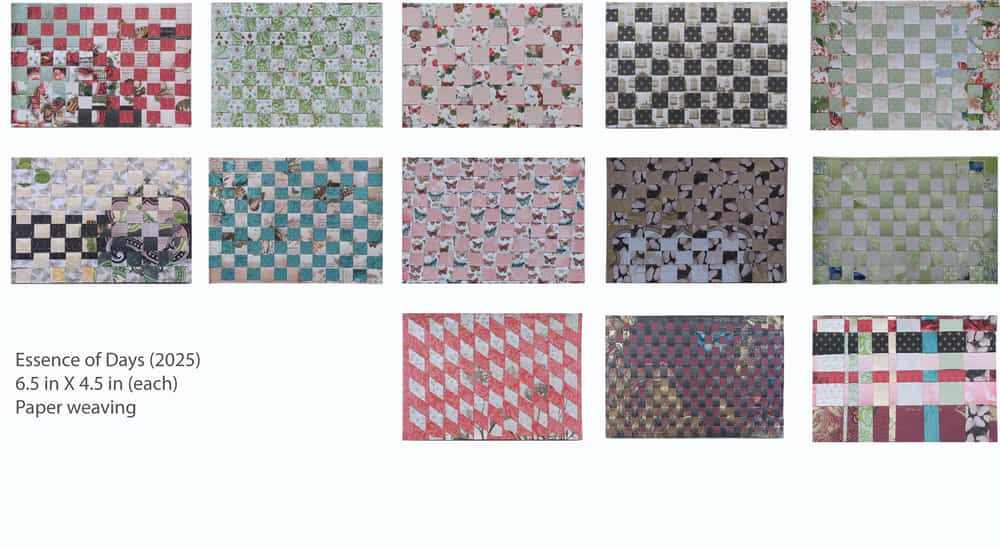
Artist Purvi Sharma finds a sense of sanity and a sense of attachment within the realm of mundane experiences and surroundings that form a significant part of her art. She draws inspiration from her current space and surroundings and visualises it in the form of shapes and layers which help her create structures that she happily calls home. Her interest in patterns began with photographing buildings, windows, old city markets, shop displays, shadows and temporary arrangements of objects, making her realise how the surroundings reflect our habits and emotional states. The grids thus formed become a kind of home holding order and disorder, comfort and conflict. Its layers allow different experiences to remain together without being resolved.
The tension between structure and disorder in her art is closely related to how Purvi understands the mind that creates natural loops of comfort, distraction, avoidance, and ego. These layers become traces of accumulated observations and changing states of mind. They do not preserve memory exactly, rather they show how experiences overlap, become distorted and acquire new meanings over time. There is an underlying pattern of repetition in these structures that reflects the daily routines and recurring patterns of thought. This repetition allows her to experience time not as a perfect cycle, but as a rhythm that holds both continuity and change, stillness and movement. The resulting structures thus formed can be understood as maps of metal movement rather than organised diagrams of the mind. They register concentration, anxiety, attachment, interruption and stillness showing how inner and outer experiences continually reshape one another. Through this process, the art gradually moves beyond its original function and begins to carry an emotional or psychological presence.
The tension between structure and disorder in her art is closely related to how Purvi understands the mind that creates natural loops of comfort, distraction, avoidance, and ego. These layers become traces of accumulated observations and changing states of mind. They do not preserve memory exactly, rather they show how experiences overlap, become distorted and acquire new meanings over time. There is an underlying pattern of repetition in these structures that reflects the daily routines and recurring patterns of thought. This repetition allows her to experience time not as a perfect cycle, but as a rhythm that holds both continuity and change, stillness and movement. The resulting structures thus formed can be understood as maps of metal movement rather than organised diagrams of the mind. They register concentration, anxiety, attachment, interruption and stillness showing how inner and outer experiences continually reshape one another. Through this process, the art gradually moves beyond its original function and begins to carry an emotional or psychological presence.
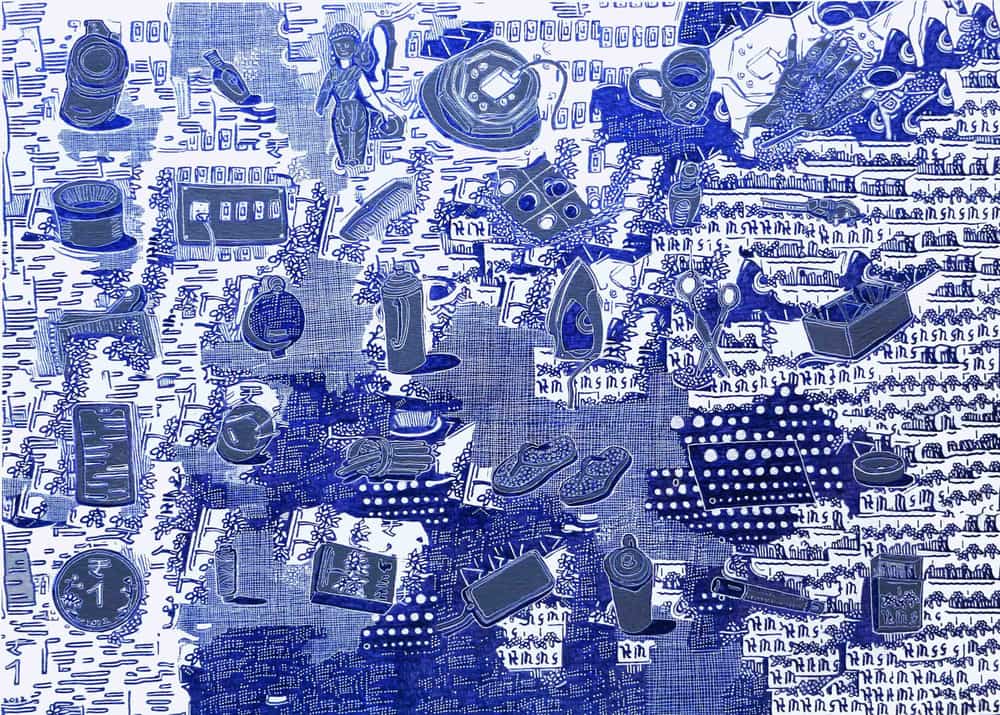
things you will see in my room, 2021
pen and acrylic color on digital print28.7 x 39.11 cm | 11.3 x 15.4 in
KSHITIJ BAHL
Artist Kshitij Bahl explores the intersection of geometry and colour, drawing inspiration from his surroundings. He has always been drawn to geometry for its simplicity. Reducing the dense, chaotic, and constantly shifting things in the world down to rudimentary geometric relationships is his way of making a sense of things. He believes that Architecture trains one to look at how a space is constructed and organised, and applying that skill to his art gives him a clear set of guidelines, like a personal mini rule book, to communicate how he experiences the world.
Fascinated by Pareidolia, Kshitij uncovers patterns in text, sounds, and spaces, infusing his art with a sense of hidden order. There is nice irony to pareidolia : you are inventing patterns that aren’t technically there, but doing so forces you to actually see what is there. Spotting patterns in the mundane is his way of breaking out of a loop, and doing so helps him to fully experience an object, a system, or an event, discover its own weird logic and how it is connected to everything around it. Patterns and geometry gives him a way to translate his odd, passing observations into something visual.
Kshitij employs Morse code to visualise the structure of various texts, ranging from everyday conversations to notable poetry. By taking the binary rhythm of dots and dashes, shifting their lengths, arranging them into grids, and introducing colour, the transcription becomes subjective. It moves beyond a literal translation, giving the original text or sound a physical presence with its own visual weight and cadence. Just like any other language, geometry has its own rules and to communicate through it, one must grapple with its grammar. One has to learn to listen to it and speak it. He hopes that the composition, rhythm, and the layers of the work invite the viewers to experience their own moment of pareidolia, pushing them to find their own patterns and associations.
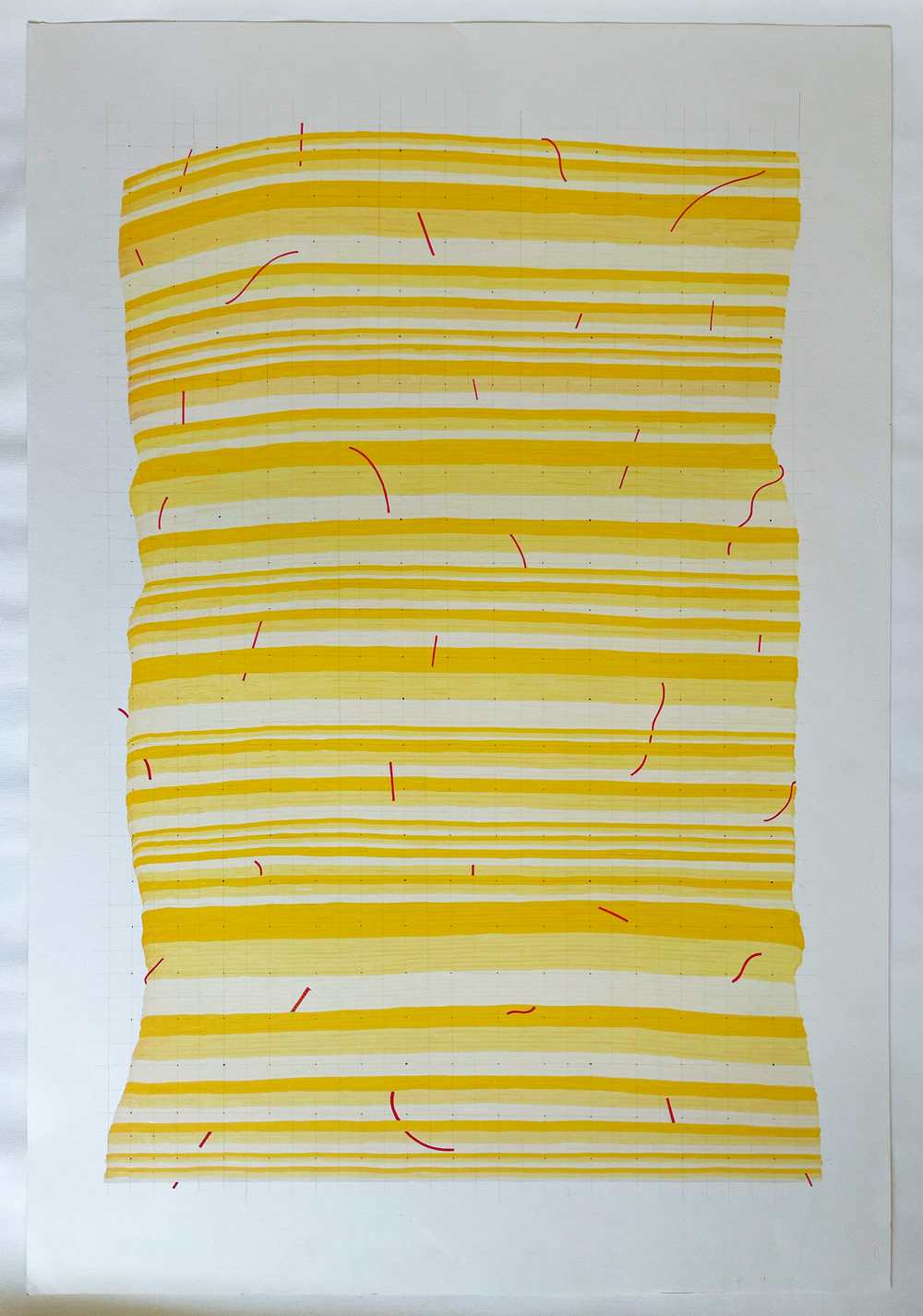
Lines - Sediments, 2025
Acrylic markers on 300gsm paper118.8 x 84.7 cm | 46.8 x 33.1 in (without Frame)
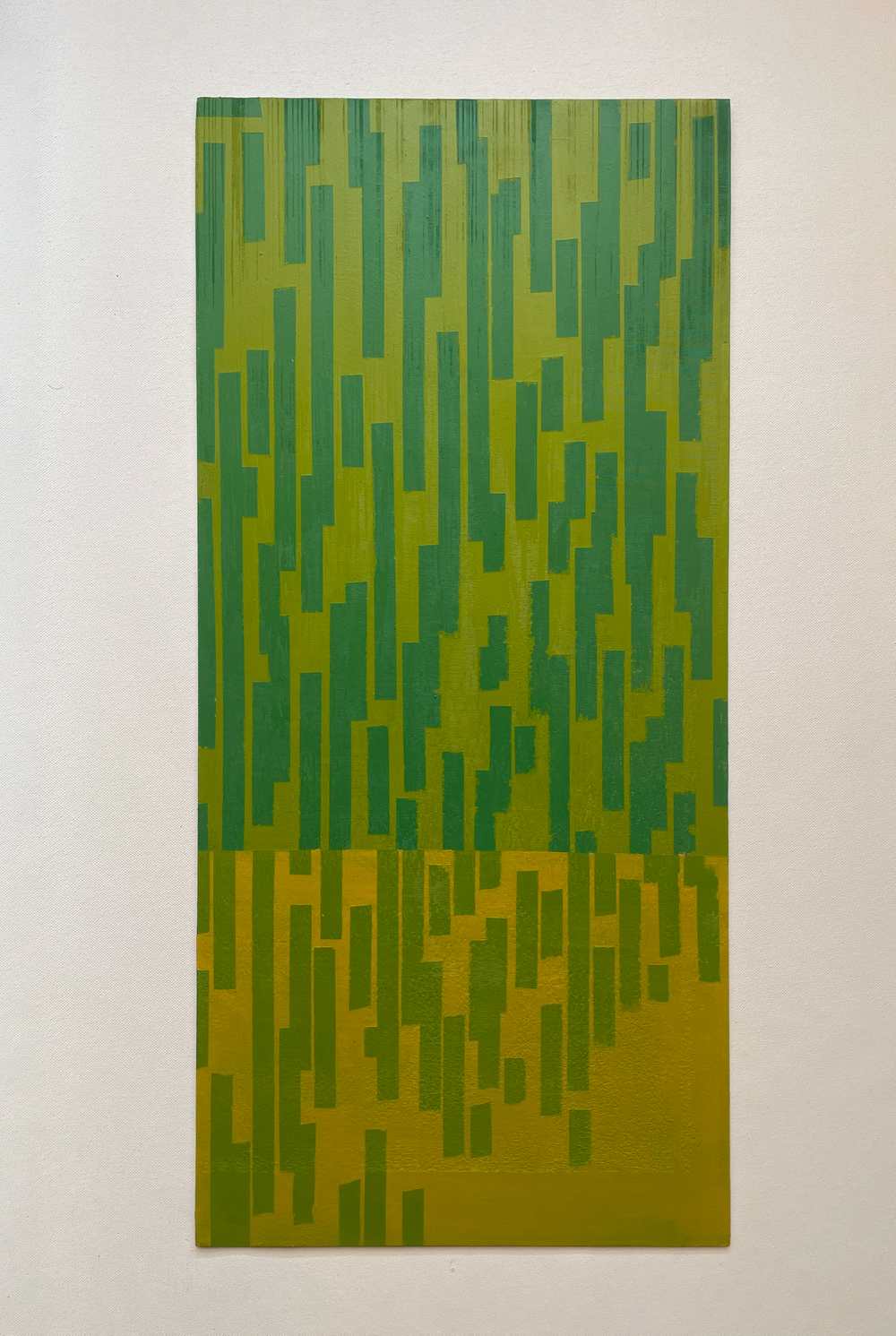
JYOTIPRAKASH PRADHAN
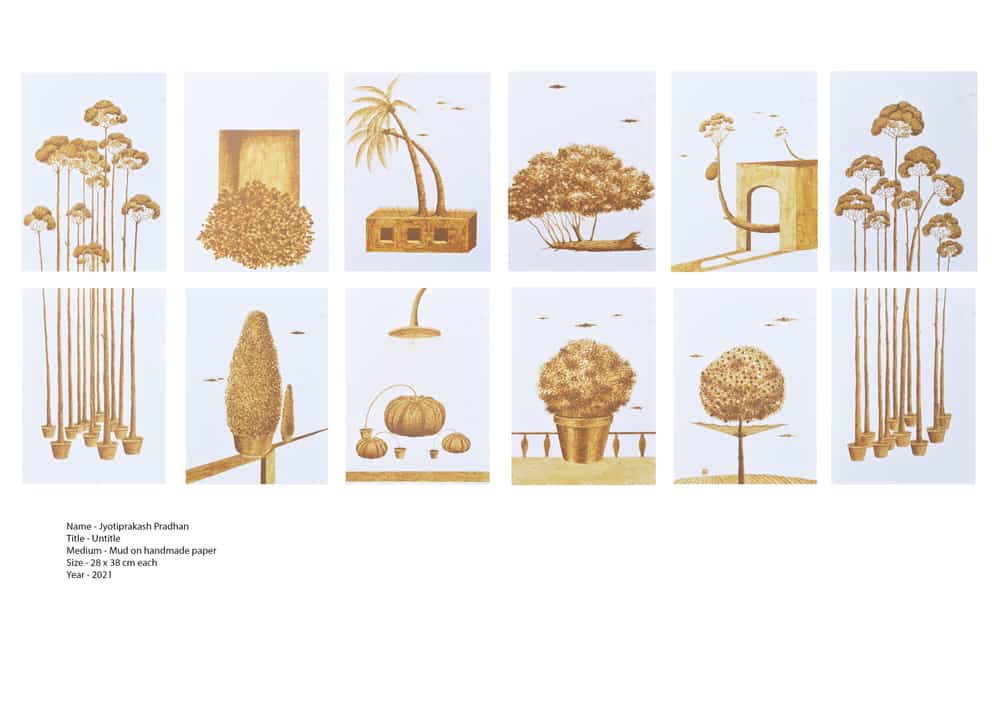
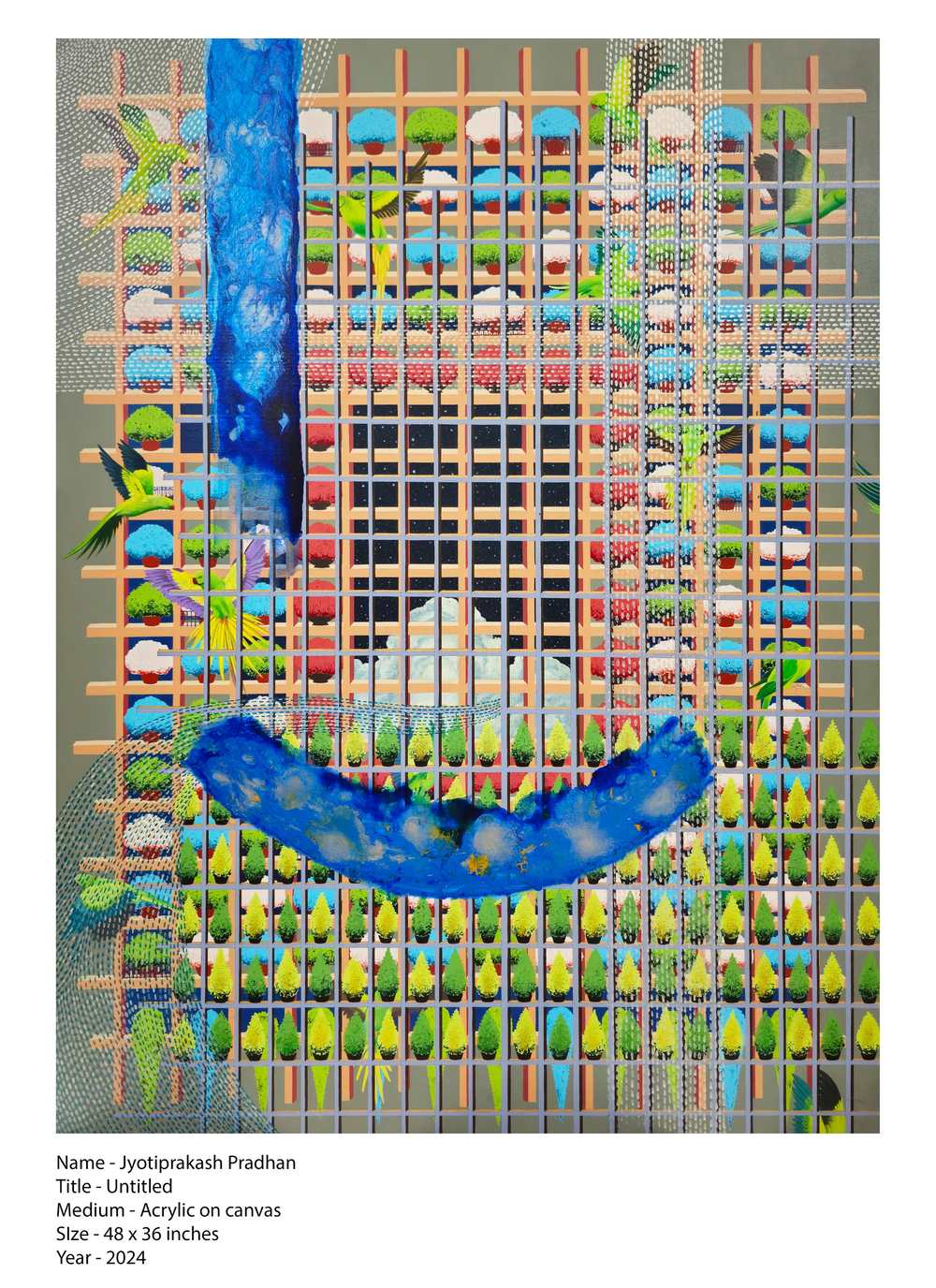
Artist Jyotiprakash Pradhan uses patterns and geometric structures to show how nature and human made spaces exist together. By bringing different forms of urban structures together, he depicts how plants enter, adapt to, and change human made spaces, that helps him to create a visual connection between rural landscapes, where nature grows more freely, and urban landscapes where nature is controlled or organised by humans. He believes that when we closely observe the world around us, we can see the patterns of repetitions and the relationship between time and space.
Jyotiprakash brings repetition and geometry together in his compositions to show the tension and how nature continuously enters, negotiates, and changes spaces that are designed and controlled by humans. He builds his paintings through different layers, which sometimes relate to a particular space and its history, and sometimes develop spontaneously during the painting process. In this way, the layers bring together different moments, observations, and experiences within the same space.
Visual discovery is an important part of his work. Once the viewers spend some time with the painting and gradually discover connections between different forms and patterns. At first one might notice the overall structure and composition, but as they look more closely, they can find smaller details, repetitions, textures, and relationships between forms. Jyotiprakash’s art doesn’t control what the viewers should see first, instead it leaves space for them to build their own observations and interpretations.