
#InConversation with Jyoti Naoki Eri
By Jyoti Naoki Eri | Oct 15 2026 · 30 mins
Could you take us back to the beginning of your journey and tell us something about the person you were before becoming an artist? What were you drawn to, curious about, or fascinated by when you were younger?
Ans : It's actually quite difficult to imagine myself as a non-artist. Art and artists were always around me since my childhood, so it was very natural to be influenced by their presence. I was born into an artist family in Kyoto, Japan, in 1975. Since my childhood, I knew I would become an artist. The only question I had was what kind of artist I wanted to become. Nature was always my inspiration. When I was small, I spent a lot of time by rivers, ponds, and also in our home garden, enjoying observing the ecosystems in nature. I used to play computer games in my early teens, and was later deeply inspired by counterculture like skateboarding, fashion, music, and the underground art scene. These were not just phases — they are still alive in me. I deeply cherish my diverse background, and I believe everything I loved shaped my personality and creative ability.
Do you remember the first moment when you felt that art was not simply something you enjoyed, but something you needed to engage with more deeply? What fascinated you about the craft? Did people, places, traditions or experiences influence you to paint? Looking back, can you recognise their influence in your work today?
Ans : My family is probably the strongest influence on my art. I was exposed to a wide range of arts and crafts, and to people involved in the art world since my childhood. I also had chances to create art using different materials. I can still vividly recall one pivotal experience. It was a life-changing moment, when I observed my hands moving and carving a deity beyond my will, when I was around 10 years old. When I was small, I often sat and did some wood carving next to my grandfather, who was considered one of the best Buddhist sculptors of his era in Japan. He was already retired, and my father had taken over the studio. One day, I got a piece of pine wood from my grandfather and started carving next to him, like I was always doing. Then suddenly I noticed my hands were moving without my effort, and at the same time I was an observer of the event. This experience was intense. It may have lasted 30 minutes or an hour — I don't know, but it felt beyond the linear time frame. When I showed the work to my father, he didn't believe that it was done by me, since the results were quite impressive. This was my first experience of the mysterious power of creating art. It was as if I was channeling inspiration and energy through myself as an instrument. After that experience, I tried quite hard to reproduce the moment again and again, but it never came back in such a vivid way. What I knew, even as a small boy, was that it had more to do with inner attitude than with technique. It led me to a deep realisation that being an artist is not an occupation, but the capacity to receive inspiration and express
it. However, only recently, after over 30 years of professional practice, I started to regain a similar touch to that of the special moment. My first and foremost influence in art is my family and our family studio. Although I am not pursuing a traditional path, they showed me the deep connection between creative energy, life, and being an artist. They also showed me that it is important to have discipline to be an artist, and that artists need to engage in daily activities like cleaning the house, cooking, accounting, and taking care of family.
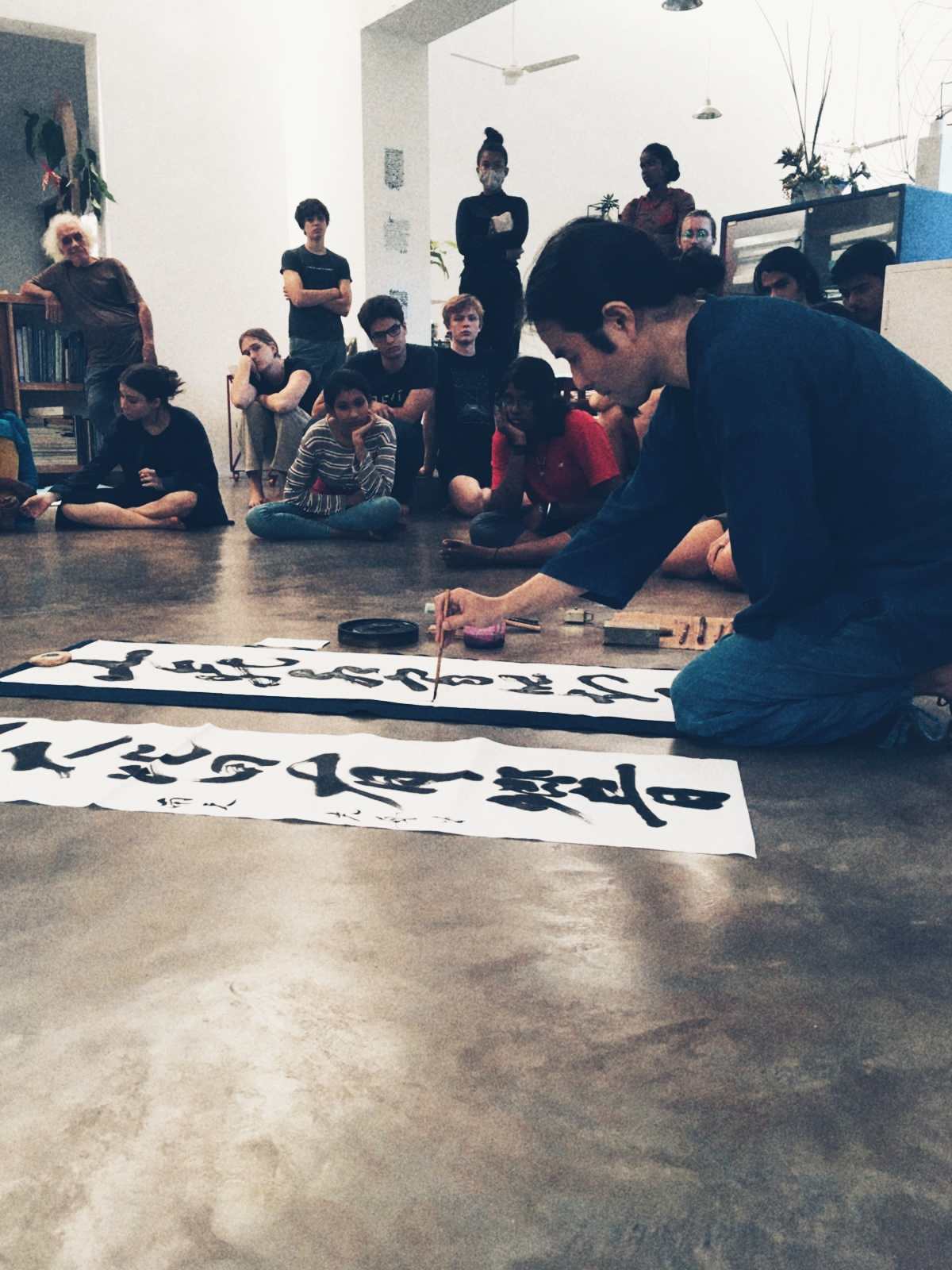
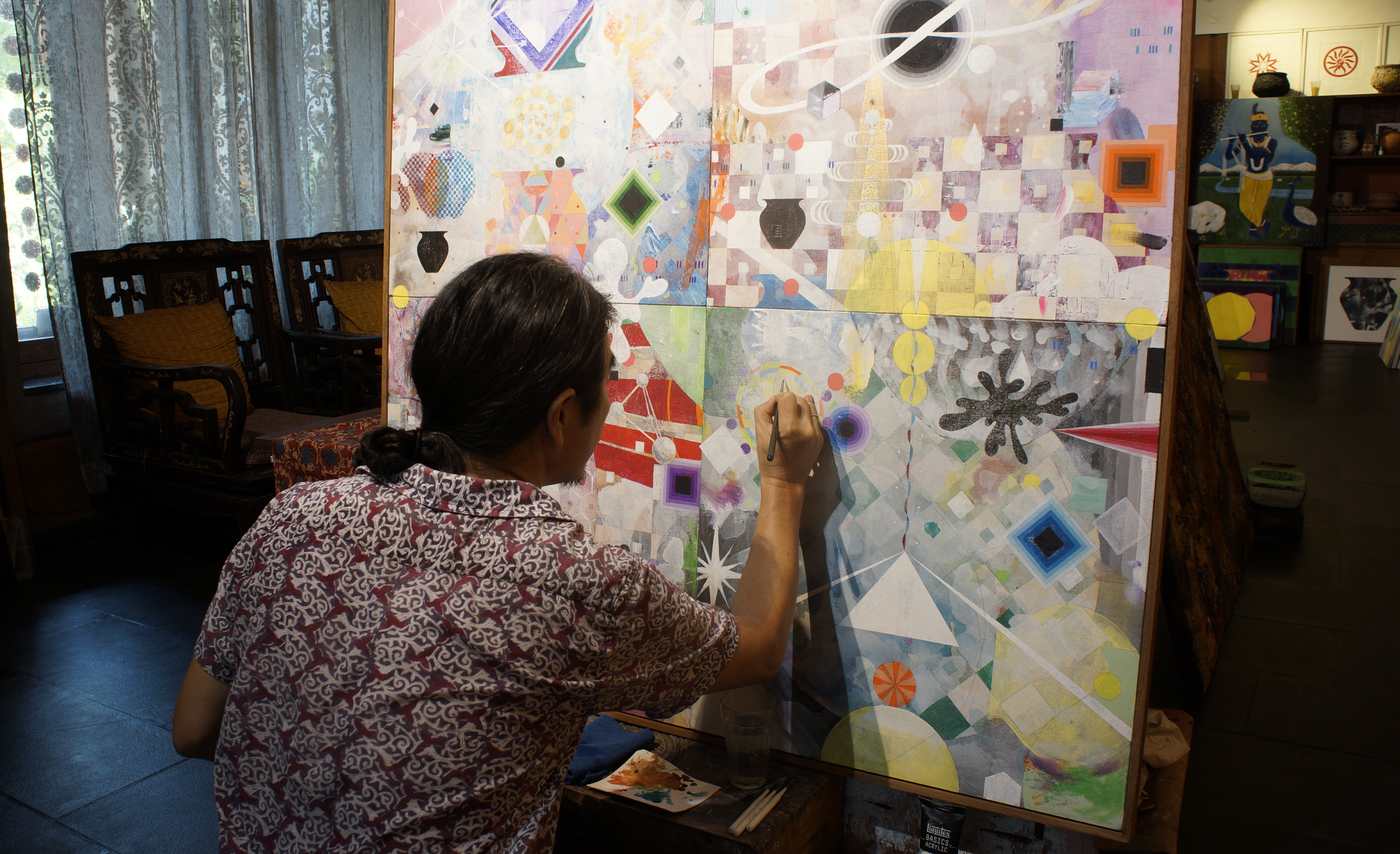
Jyoti Naoki Eri in his studio
Your practice sits at a very personal confluence of culture, spirituality, nature and experimentation. Did this way of thinking emerge organically or was there a particular turning point that brought all these interests together?
Ans : Because my family was deeply devoted to Buddhism, and I learned a lot from old religious art masterpieces, it was natural for me to think that art and divinity are connected, and that the relationship between divine presence, nature, and universal law is what triggered humans to start creating art. Even in this modern time, dominated by conceptual art in the contemporary art scene, I didn't lose this focus on art as spiritual expression. Learning art history from ancient to medieval times, I became certain that art is offered in service of timelessness and beauty. Some art in our present time looks quite lost under the influence of egocentric individualism and capitalism; on the other hand, religious art today seems to have lost its spiritual freedom, caged in dogma and conservatism. It's not easy to remain out of the box in a closed and strict society. In general, the negative side of a traditional society is in its judgemental attitude towards others or new forms of expression. It suffocates people and oppresses younger generations. Difficult circumstances help people grow strong, but not everyone can make it through. To me, experimentation is a default attitude to maintain openness and learn new things. Repetition is great but it should be able to invite fresh air.
You have lived in Auroville for around two decades. What inspired you to go there and what made you decide to stay? In what ways has Auroville changed you – not only as an artist, but also as a person? Has your understanding of Auroville changed over these twenty years?
Ans : I discovered Auroville without prior information, as it was not well known in Japan 20 years ago. I was travelling in India after my trip to Tibet and Nepal in 2004. I stayed at Arunachala mountain in Thiruvannamalai. I saw some Auroville products in a small shop and read a very short description about Matrimandir. I heard it was only a two-and-a-half-hour trip by bus, so I just thought of visiting for two hours, out of curiosity to see Matrimandir. I really had no great expectations. However, visiting Matrimandir made a great impact on me, because of the quality and scale, and of course the concept too. But what struck me most was the fact that it was mostly built by residents and local labourers. During my travels I visited temples and ashrams, but Auroville's engagement in material realisation was something very different from what I had seen in other spiritual communities. I also liked the proximity to nature. I decided to live in Auroville and continue my art and spiritual study, as I felt this was close to what I had been seeking over the past years. Auroville, and India as a whole, have changed a lot, and become materially more abundant compared to 20 years ago. Auroville and its people helped me to change a lot. Naturally, we have numerous challenges in such an experimental international community. Auroville's dream of human unity in diversity is still in the making and will remain in the making. Today in Auroville, our participatory governance and collaborative community organisation are under challenge, as the present government has started to interfere with internal governance. While challenges are bound to happen in such an experimental international township, our current challenge is no longer about differences in understanding or ideology among the residents. No matter what the circumstances are, my love for Auroville is still here and growing, as it offers constant progress. My belief is that in such strong pressure in the world, artists have a role to create meaningful art — turning hate into love, ignorance into knowledge, darkness into light. In history, masterpieces were often created in challenging moments in their society. I cannot help but think that our time is one of these moments.
How much of your artistic vocabulary comes from simply living in Auroville? Is there a particular place, landscape, person or everyday experience there that has stayed with you and eventually found its way into your work, even indirectly?
Ans : The teachings of Sri Aurobindo and the Mother are definitely inspiring. At the same time, I do not intentionally use their words in my artwork. Unless I am able to experience and digest what I learn through my life in Auroville or in India, these expressions would be only borrowed ideas, and not authentic. They are spiritual guides, but not religious leaders. For my art, I rely on my own inspiration and not external words. In my humble imagination, all great masters would want people to be genuine and find their own path — not a copy of someone else, or living a false personality. I was fortunate to meet some spiritual and art masters in my life. However, the deepest influence came from my artist parents and my birthplace, Kyoto, with its depth of traditional culture and its closeness to, and respect for, nature. In Auroville, my wife and son are an inspiration in daily life as well. We often make art together or experiment with cooking. I believe all education and learning experiences are only preparatory processes. One has to go through a deep unlearning process in order to truly progress and express in his or her own way.
You describe time as an essential medium in your artistic practice. When you look at your earliest works alongside what you are making today, what changes do you notice — not just technically, but in the way you think, feel and perceive? What does it mean for you to treat time itself as a medium?
Ans : I enjoy seeing my past artworks and often discover new aspects in them. I almost feel like they were made by someone else. At a younger age, I was more caught up in figurative precision and mastery, as I was hugely influenced by old masters in the East and West. At the same time, from a younger age I liked the surrealist masters, as they suggested different realities. Primitive arts are also very special in their refined simplicity. They were like whispers to my spirit that life is not just as it seems. This interest in alternative realities led me to yoga and meditation. I love a wide range of art forms, and I like to keep discovering new things in them. Even beyond my likes and dislikes, art can always show me unknown aspects of life. As for my statement "Time as Medium," I consider the preparation and creation of art to be like a fermentation process. My creative process has its own time and cannot be rushed or delayed. Some artworks prefer to be kept away from my attention for some time to "mature" or to be rediscovered. In this sense, time is a very important element in the creative process. To me, the creation of art is alchemy and chemistry. Timing is an essential "ingredient."
When we look at your paintings, nature often seems to occupy more space than any identifiable object or figure. What happens when you stand in front of a landscape? Are you observing it, absorbing it, remembering it, or responding to something beyond what is physically visible? What is it about nature that continues to inspire you?
Ans : "Remembering" is an interesting observation. Perhaps I learned, through Japanese culture, how to communicate through silence and empty space. Animism is deeply embedded in the Japanese psyche, and it teaches an all-encompassing connection within nature. People say there are 84,000 gods, and the world is their pantheon. In ancient times, this number actually represented everything. My influence from Animism is very strong. So I establish my own dialogue with nature, trees, wind, and water. These are not particularly special, but the facts of life. Humans are part of nature, whether creative or destructive. Their expression follows their awareness and their spiritual proximity to nature.
Your work draws from the Eastern landscape tradition of San-sui or Shan-shui. What was it about this tradition that resonated with you so deeply? How do you interpret traditions through your contemporary practice? Do you see your work as a continuation of a traditional visual language, a reinterpretation of it, or a conversation with it?
Ans : My hometown, Kyoto, is surrounded by mountains, and it is known for its picturesque beauty through the seasons. San-sui represents a symbolic philosophical path, as the mountain path is never linear and has ups and downs. Sometimes we get into misty moments, then we have a sudden opening with breathtaking views. There are even moments when we encounter life-threatening situations. I reinterpret this tradition and its symbolism in my own way, through my experience and through the lens of yoga and modern science. My landscape paintings became a bit cosmic quite spontaneously. In fine art, often the subject and the background are well connected and stay complementary in a mystical and symbolic way. If a person and the world they live in are mirroring each other, there are many hidden signs within that landscape — light, weather, texture of air, clouds and more. My fascination with landscape painting sits there. The subject and the object are complementary, and they are inherently connected.
Ans : My hometown, Kyoto, is surrounded by mountains, and it is known for its picturesque beauty through the seasons. San-sui represents a symbolic philosophical path, as the mountain path is never linear and has ups and downs. Sometimes we get into misty moments, then we have a sudden opening with breathtaking views. There are even moments when we encounter life-threatening situations. I reinterpret this tradition and its symbolism in my own way, through my experience and through the lens of yoga and modern science. My landscape paintings became a bit cosmic quite spontaneously. In fine art, often the subject and the background are well connected and stay complementary in a mystical and symbolic way. If a person and the world they live in are mirroring each other, there are many hidden signs within that landscape — light, weather, texture of air, clouds and more. My fascination with landscape painting sits there. The subject and the object are complementary, and they are inherently connected.
Advaita Vedanta and Sri Aurobindo's philosophy are important influences on your practice. Could you tell us about your personal encounter with these ideas? What initially drew you towards them? Do you think art can communicate spiritual experiences that cannot easily be expressed through language? Have you ever made a work because you felt compelled to express something you could not articulate verbally?
Ans : Advaita Vedanta was like a confirmation of the world view I had been quietly carrying for many years — one's inseparable connection with the Universe. There is no "other." I feel it's something quite inherent in Asian culture in general as well. Sri Aurobindo represents a deeply scientific approach, and the level of his spiritual insight is impossibly precise. He is, for me, a promise of great human potential. In my current phase, I have stopped reading spiritual texts, as I believe this real life is the true spiritual book, a real-time, interactive experience. Books give us concepts and an overview, but real experience nourishes me. Family life and community life are wonderful occasions for deep learning. Ultimately, nothing is mundane or non-spiritual. The creation of art is profound. What we can express through words is limited; however, when we compress words into frames like haiku or poetry, they suddenly become profound and pregnant with meaning.
Your practice also engages with modern science and what you describe as its increasingly mystical discoveries. What aspects of contemporary science fascinate you most? What interests you about the point where scientific inquiry and spiritual thought seem to approach similar questions about existence, consciousness, time and the universe?
Ans : Current quantum physics and neuroscience research are deeply fascinating, because they deal with a more multidimensional reality and explore unexplainable phenomena of our life. For example, the possible existence of non-linear time is a great starting point for questioning our own limited understanding. What their research tells us is close to what spiritual masters describe as the invisible existence of our spirit, the power of intention, consciousness, and the continuity of life beyond individual existence. Spiritual experiences are a subjective matter, but science is starting to confirm some mysteries in life. I believe spirituality has a power yet to be proven scientifically; however, art could be a bridge between science and spirituality too. When I was a child, cosmology influenced me deeply. It naturally made me contemplative when I was under the starry sky, or even in a planetarium. It always gave me a deep sense of belonging in the vastness of the universe. In a way, I feel I'm still the same child, trying to express that feeling through art.
Could you describe your studio to us — not just physically, but emotionally? What kind of space do you need around yourself to work? How would you describe a day in your studio? Are there works that you feel particularly emotionally attached to? What makes those works different for you?
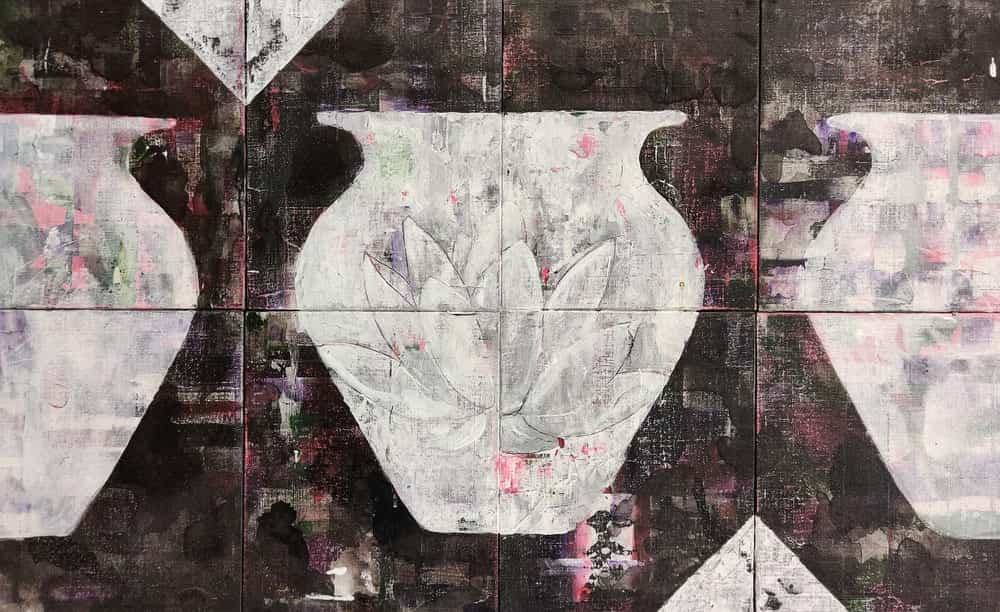
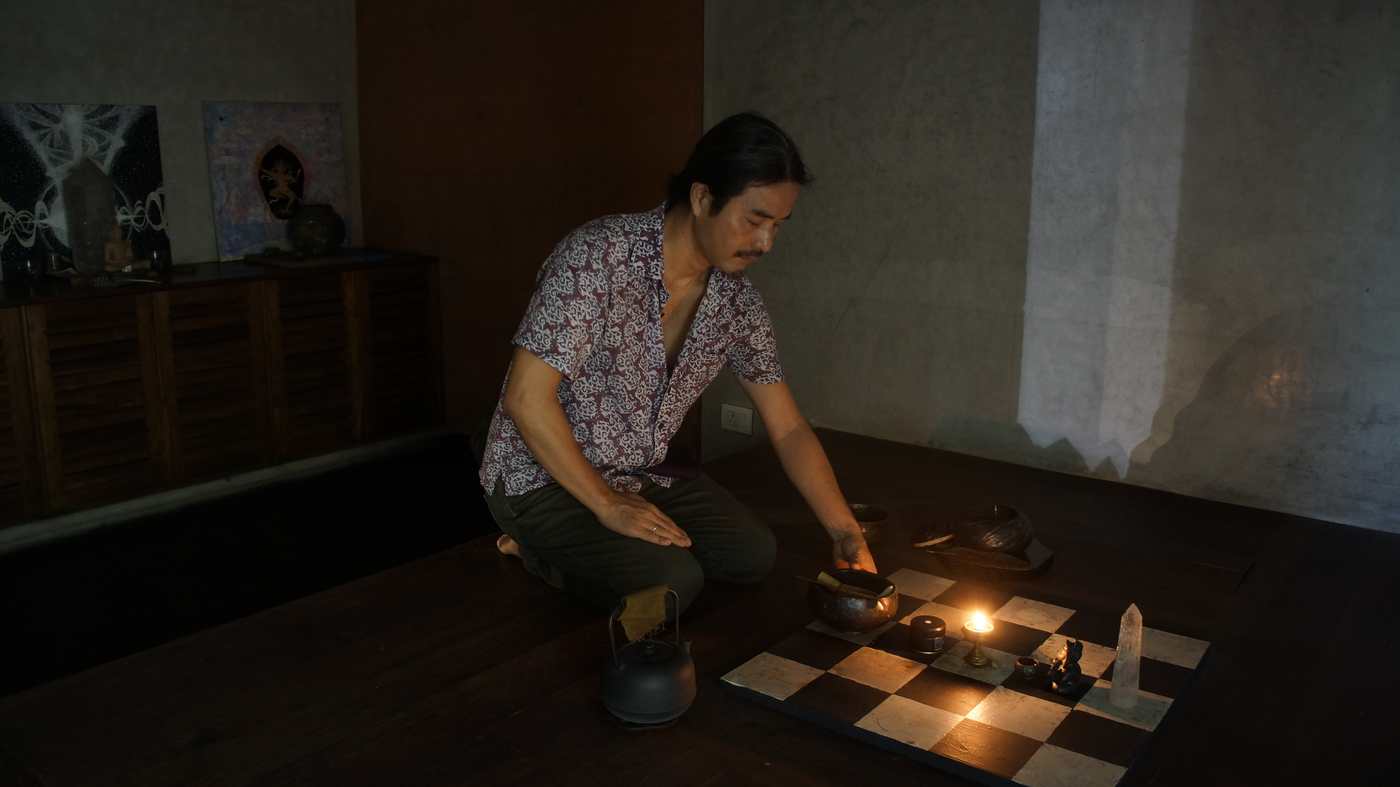
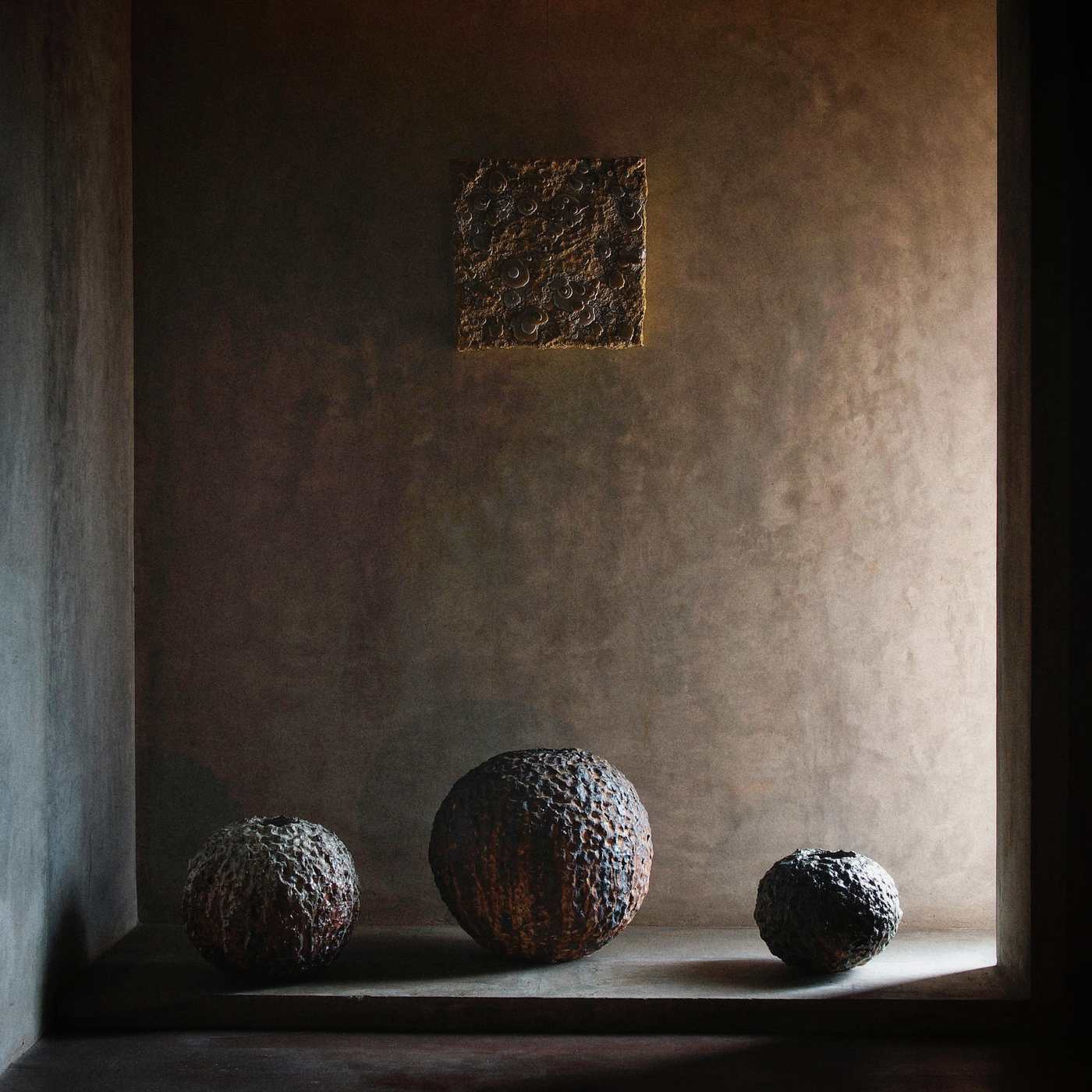
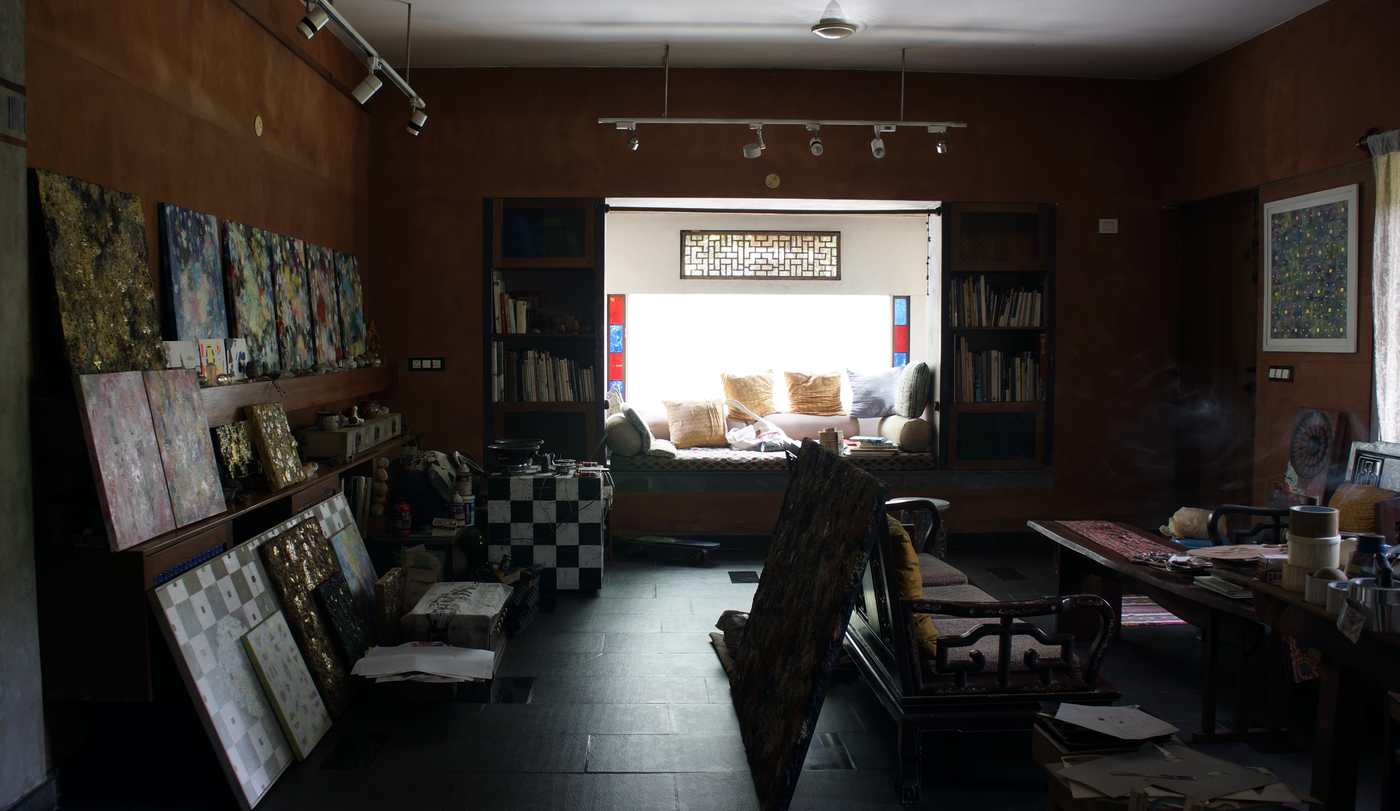
Ans : I spend most of my day in my studio in Auroville. My architect was very open to me being involved in the interior design. It was, for me, a labour of love. It's a dream place to create art, meditate, meet people, drink tea, and listen to music. Over the years, the space has become occupied by things, but I still maintain a space where I conduct tea ceremonies. Quite a few visitors say the atmosphere of the studio is fresh and inspiring. I'm profoundly grateful to have my own studio, and to be able to maintain it. I have a few ongoing series like Vessels, Lotus Ponds, Archaeology of Transcending Light and others. I honestly don't have a special attachment to particular artworks. I enjoy seeing my past works — it feels good to reconnect with the self I was when I made them.
Were there periods when you questioned your direction as an artist or felt uncertain about where your work was going? How did you navigate those moments? Do you think your work has changed because your artistic interests changed, or because you changed as a person?
Ans : It feels like the periods of self-doubt are over. I had a few tough periods in my life. At the end of my teenage years, I did not have enough clarity to pursue art as my profession, and it was also not clear whether I should follow the path of my family's art business, or follow more into the direction of free expression. Again, at the end of my twenties, I was not satisfied with the setup of my family art studio, and felt it was not the best place for me to practise art. I felt I was allowing myself to be spoiled. I didn't know exactly, but I felt strongly that I needed to seriously pursue finding my own place to live and practise art. It was probably one of the greatest challenges and risks I took, to go outside Japan to find the exact place where I wished to live, make art, and, if everything aligned well, to have a family. No matter what tests and obstacles I had to face in life, I remained faithful to my deep feelings and my own decisions. Today I have it all, and I don't have regrets about making that decision over 20 years ago. In some moments in life, the universe forces us to make a great leap. I had a few moments like this, where I had to overcome my own self-doubt and fear, and comfort in the status quo. Every time, without exception, the solution was found within.
Do you believe that an artwork carries the time that was spent making it? Can a viewer somehow sense that accumulated time when looking at a work? What would you like to tell them?
Ans : I would say it's both time and energy that we spend to make art. Time is required to give energy, so energy is the actual power of art, and time stays in the atmosphere — how we spend time to make art. Time can also be felt as the breathing of the artist. For example, when you compare the general atmosphere of the expressionists and the impressionists, the expressionist's breath is rapid, and we can feel an urge of breathlessness in it. On the other hand, impressionists breathe slowly, and they try to feel the moment and tune in to the feeling, like being part of the landscape. In some old religious arts, you may feel the breath in the calmness in the art pieces. That time flow is slow, sensitive and often elegant. We can also relate to time in art in this way. I believe one can sense this in literature and other art forms too.
Is there something completely unrelated to art that you are deeply passionate about?
Ans : I honestly cannot find anything unrelated to art in my life. However, trying to learn about how world politics and the financial world function is something I always cherish, as I can learn many things beyond my daily habits. It's probably a way to balance out and utilise my left brain, as my creative work is often more of a right-brain, intuitive process, quite isolated from the world of politics and economics. My wife is a good cook, but I cook quite seriously as well. Lately, I have a few ongoing venture business consultancy, branding, and culinary design projects this year, in India and Japan. So, they may all seem unrelated to art, but I cannot separate them from art.